Team building volunteer ideas can go sideways when the day is built around what looks good in photos instead of what a shelter actually needs. For leaders, donors, and volunteer teams supporting women, children, and families after crisis, that difference matters.
The best projects make daily life easier, whether that means clearing a packed pantry, repainting a worn common room, or stocking fresh towels by 9 a.m. Ask staff first. Always.
Do work that still helps after your team leaves.
1. Painting Shelter Common Areas and Murals at Families Moving Forward in Durham, North Carolina
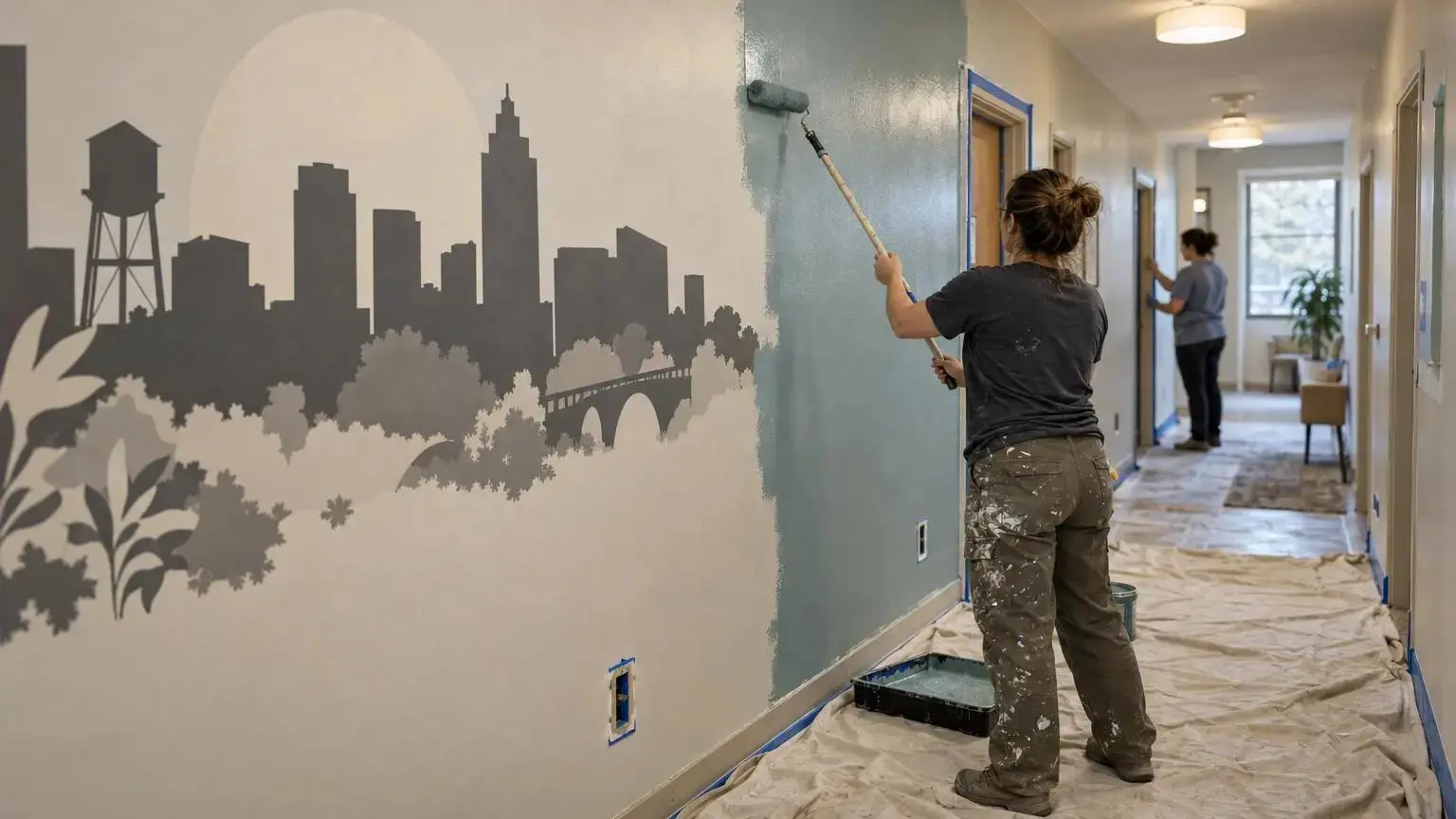
For a lot of teams, painting is the easiest way to feel like the day mattered. You can see progress by lunch. By the end, the room looks different. That matters for morale, but it also matters for shelters that need a shared space to feel calmer and more welcoming without taking on a full furnishing project.
At Families Moving Forward in Durham, volunteers painted a main hallway, created a Durham skyline inspired mural, and updated a multipurpose room to feel more cheerful and inviting. That mix is why painting stays near the top of our list of team building volunteer ideas. It gives people clear roles, keeps the work moving, and leaves a visible result.
Painting also sits in a different lane than cleaning or repairs. It’s more design-forward and more public-facing. Residents, staff, and visitors will all see it. That’s a strength, but it also means you need tighter approval on color, imagery, finish, and placement.
A few things make or break these company volunteer events:
- surface prep usually takes longer than volunteers expect
- low odor products matter when people are living or working nearby
- high traffic walls need durable finishes, not just pretty ones
- drying time can disrupt meal service, intake, or child programming if the schedule isn’t tight
One operator truth here: volunteers love murals, but shelters don’t need a branding exercise. They need spaces that feel respectful and settled. If the design starts sounding more like a company culture wall than a shelter improvement, stop and reset.
A good paint day changes the room. A bad one creates more work for staff.
2. Deep-Clean and Organize Shelter Spaces in Everett, Washington
This is one of the most useful corporate volunteer project ideas when a shelter is stretched thin and needs help now. It’s less glamorous. It’s often far more helpful.
At a family shelter in Everett, volunteers cleaned and reorganized kitchen, pantry, and storage areas. That kind of work rarely makes for dramatic photos, but it can change a staff member’s whole week. When supplies are buried, food storage is messy, or turnover between families is moving too fast, order matters.
This option works especially well for larger groups because the jobs are easy to divide without much training. You can set up stations for sorting, wiping, labeling, restocking, and trash removal. It also fits shelters that don’t have time for design planning or procurement before the event.
The tradeoff is visibility. Cleaning and organizing won’t feel as celebratory as painting bedrooms or building furniture. But if the shelter’s systems are strained, don’t chase the more photogenic project.
Practical details count here:
- Staff should set the keep, donate, discard, and relocate rules.
- Food handling needs to follow the shelter’s own protocols.
- Labels should match how staff already work, not how volunteers think they should work.
- Disposal decisions should never be made casually in a back room by people who don’t run the site.
We’ve seen this go sideways when a team tries to “improve” a pantry without understanding what has to stay where for daily operations. Clean isn’t the goal. Usable is.
3. Create Shelter Gardens and Improve Landscaping at an Everett, Washington Family Shelter
Some teams need to move. They don’t want eight hours indoors with rollers or storage bins. Outdoor projects can be a better fit, and they widen the idea of corporate volunteering at shelters beyond what happens inside the building.
In Everett, volunteers added landscaping, built raised garden beds, weeded, added new soil, spread gravel on walking paths, and handled other site improvements. That’s a solid example of what outdoor work can look like when the property itself needs attention.
There are a few reasons this format works:
- bigger groups can spread out without crowding staff or residents
- indoor shelter routines face less disruption
- paths, seating areas, and entrances often improve right away
- the work feels active, which some volunteer groups prefer
But outdoor projects have sharper edges than people think. Weather can wreck the schedule. Beds need upkeep after the event. Gravel paths need to be accessible, not just neat. If irrigation is weak or no one has time to weed later, a nice looking install can turn into a burden within weeks.
This is best for teams that are comfortable with physical labor and don’t mind a workday that may be muddy, hot, or both. It also works best when the shelter has already decided who will maintain the space after the volunteers leave.
The simple test is this: does the project improve how people move through and use the property every day? If not, it may be decoration disguised as service.
4. Assembling Furniture and Installing Outdoor Seating at a Domestic-Violence Shelter in Apache Junction, Arizona
Furniture assembly is one of those company volunteer events that tends to run cleanly when the prep is solid. The tasks are structured. The outputs are countable. By late afternoon, you can point to finished pieces and say, “we got that done.”
At a domestic-violence shelter in Apache Junction, volunteers worked on several property improvements, including assembling furniture and installing outdoor seating. That’s a practical middle ground between simple cleaning and full renovation work.
It suits shelters that already have purchased items, a site plan, and designated spots for placement. Without those three things, the day gets messy fast.
A few planning points matter more than people expect:
Before the event
- confirm deliveries arrive before volunteers do
- check that all hardware and instructions are onsite
- sort tools by station so teams aren’t wandering around looking for one Allen key
- get staff signoff on where each piece will live
During installation
- outdoor pieces need durability, not just a low price
- anchoring or placement decisions should be made by staff or facilities leads
- don’t let volunteers improvise layout in resident areas
This type of project often pairs well with another workstream. Some volunteers can assemble benches or tables while others paint, garden, or clean. That mixed agenda is useful when your team has very different comfort levels.
5. Care Kit Assembly CSR Event for Shelter and Crisis-Center Support
Sometimes the right answer is not onsite at all. If travel is difficult, the team is spread out, or the event is tied to a conference schedule, care kit assembly can be one of the easiest corporate volunteer day ideas to run well.
The appeal is obvious. The donation is countable, portable, and ready to hand over at the end. That clarity helps internal planning, especially for distributed teams or short company service day projects.
But this format is different from shelter improvement work. It is donation-focused, not environment-focused. That’s not a flaw. It’s just important to be honest about what it does and doesn’t do.
Care kits can support people facing homelessness or crisis, but the exact contents should come from the shelter’s current wish list. Otherwise you get well-meant donations that create sorting work, storage problems, or expired inventory.
Use a basic filter before you commit:
- can the recipient store the kits now
- are the items relevant this month, not six months ago
- will the presentation feel dignified
- can your team label and transport everything responsibly
This format scales easily. That’s the good news. The hard truth is that it won’t improve bedrooms, common areas, or site conditions. If your shelter partner needs a place to function better, care kits are not a substitute.
6. Shelter Repairs and Renovations (Hampton Roads, Virginia)
This is the ambitious end of the list. Repairs and renovations can solve real facility problems, but they ask more from everyone involved.
In Hampton Roads, volunteers handled a wide scope across emergency shelters, including replacing counters, cabinets, appliances, and light fixtures, deep cleaning living spaces, power washing exteriors, and painting common spaces and bedrooms. That’s not a casual service day. That’s a managed project.
These company service day projects make sense when a business can bring more than volunteer labor. Donated materials help. Skilled labor helps more. A shelter with aging infrastructure or multiple units often needs both.
The upside is straightforward: repairs can address the stuff that actually gets in the way of daily operations. Worn counters. Bad lighting. Broken fixtures. Tired shared spaces that drag on staff and residents every day.
The limits are just as real:
- some work requires licensed trades
- procurement lead times can slip the whole timeline
- scope grows quickly when people start noticing “one more thing”
- safety oversight can’t be improvised on event day
We’ve learned to be strict here. Do not promise a full transformation if the project plan only supports partial work. Half-finished repair jobs create stress, not relief.
The strongest version of this is a partnership with shelter staff, not a one-day push imposed from the outside.
7. Toy and Book Carts for Shelter Shared Spaces (Durham, NC)
Not every volunteer day needs to be big to be useful. Focused build projects can solve a real problem without taking over the whole facility.
At Families Moving Forward in Durham, volunteers planned and created toy and book carts so items could move throughout the shelter more easily. For family shelters, that kind of mobile storage is more practical than it sounds. Shared resources often need to travel from one room to another, especially when children’s activities shift during the day.
This idea is a smart fit for smaller groups, maker-minded teams, or sponsors that can provide both materials and simple design support. It gives volunteers a concrete task and leaves the shelter with a custom physical asset.
It also compares well with care kit work. Both are manageable and compact. The difference is that carts stay in the building and support day to day operations.
A few details deserve real attention:
- cart width has to match hallways and storage spots
- wheels need to roll well and hold up
- surfaces should be easy to clean
- edges and hardware should be safe around children
- staff need a simple plan for where the carts live when not in use
That last point gets missed all the time. Useful items become clutter if no one has a place for them.
8. Refresh Resident Rooms With Bedding and Towels at a Domestic-Violence Shelter
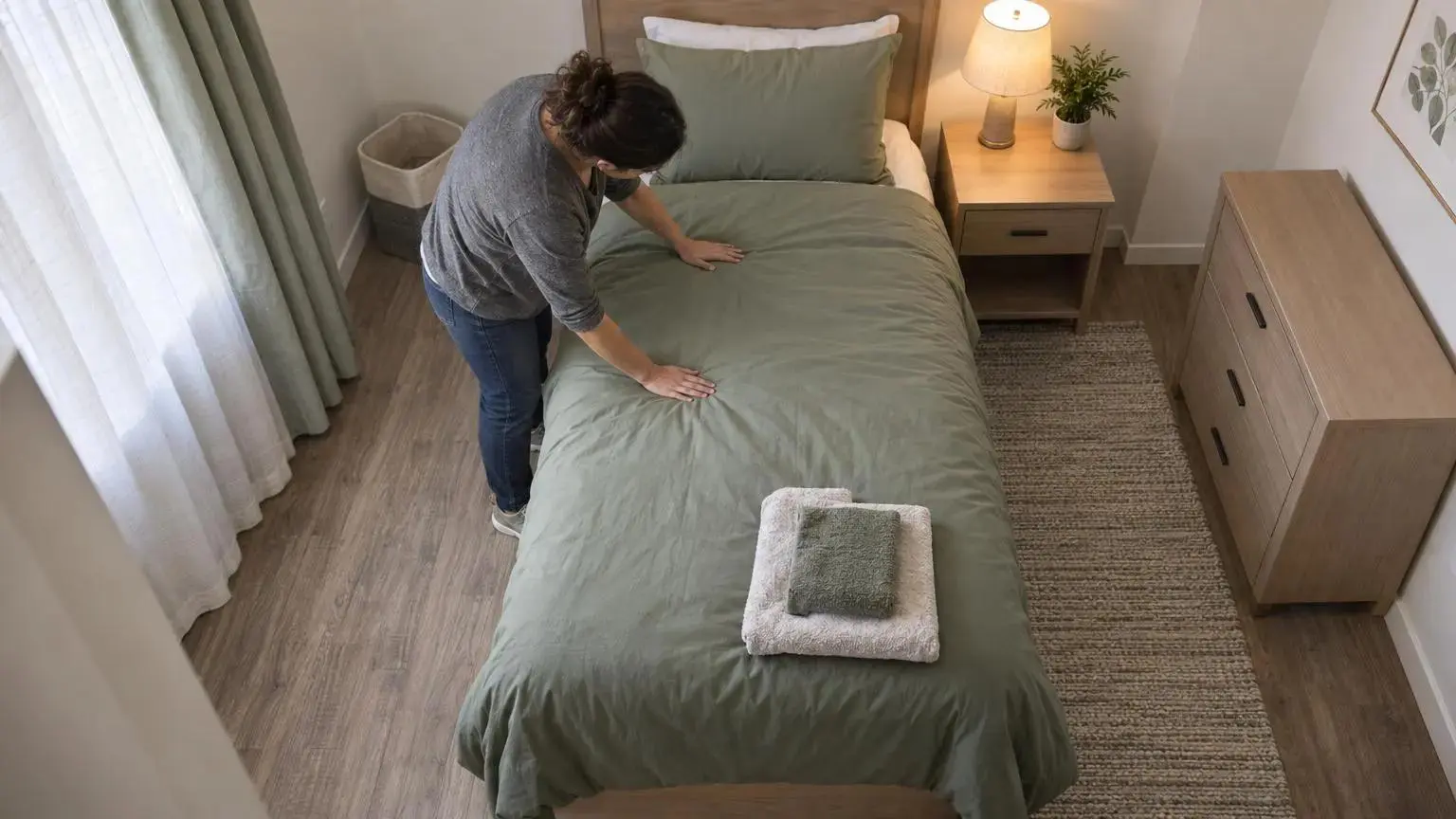
This is one of the most resident-centered team building volunteer ideas on the list, and it asks for more care than people expect. Bedrooms are personal, even in temporary housing. You don’t treat them like a generic volunteer zone.
In one documented project, volunteers painted 15 bedrooms, a playroom, and a dining room, and raised funds to purchase bedding and towels for residents. For companies that want both hands-on service and a donation component, this format can work very well.
It differs from common-area work in an important way. Shared rooms can absorb more visual energy. Bedrooms need restraint. Color, privacy, layout, and comfort all matter more when someone is trying to sleep, calm down, or care for a child after a hard day.
That’s where trauma-informed design becomes useful in real terms, not just as a nice phrase. We think about light, sound, color, privacy, and what belongs in the room versus what just fills space. A room can look “finished” and still feel wrong.
When shelters want room-level improvements shaped around resident needs, our Room Makeovers can help guide that process. Not every room needs a total overhaul. But it should feel calm, practical, and respectful.
Watch the operational details too:
- resident turnover may be fast
- linen standards need to stay consistent
- storage and laundering realities matter
- some donated items don’t belong in personal spaces at all
A good room refresh doesn’t just look better in photos. It feels easier to live in.
How to Choose the Right Shelter Project for Your Team
The right project depends less on volunteer enthusiasm than on fit. Shelter priorities come first. Then team size, budget, skill level, and available time.
Start with five questions:
- What does the shelter need most right now?
- How many volunteers are you actually managing?
- Is the budget mostly labor, goods, or both?
- Does the team have any skilled trades or build capacity?
- How much prep can happen before event day?
Onsite company volunteer events usually create stronger place-based impact. Offsite events are easier to run and easier to scale. Neither is automatically better.
Some quick matching helps:
- large teams with mixed abilities often fit cleaning, painting, or care kits
- smaller skilled groups often fit repairs, builds, or furniture assembly
- teams that want a deeper relationship with a shelter usually fit room or common-area improvement work
Also check the practical friction points: weather exposure, resident privacy, supervision capacity, and how much purchasing has to happen ahead of time.
The best team building volunteer ideas don’t start with what sounds good in an internal email. They start with what the shelter is carrying.
Published project reports illustrate how widely volunteer headcounts can vary: 36 people were planned for the Durham service day, about 250 volunteers worked at the Everett shelter site, and 60 people refreshed rooms at a Des Moines domestic-violence shelter. These are project-specific reports, not recommended team-size targets.
The widest example combined many workstreams—cleaning, painting, landscaping, fencing, garden beds, and path work—so its larger headcount should not be treated as a standard for a single-task project. Match the group to the shelter’s supervision capacity and the amount of work that can be prepared before volunteers arrive.
| Project | Best fit team | Why it fits | Main watch-outs |
|---|---|---|---|
| Cleaning and organizing | Large teams with mixed abilities | Jobs are easy to divide with little training, and the work can help immediately when shelter systems are strained | Staff should set keep, donate, discard, and relocate rules; food handling and labels should follow shelter operations |
| Painting common areas | Large teams with mixed abilities | It gives volunteers clear roles and leaves a visible place-based result | Get tight approval on color, imagery, finish, and placement; plan for surface prep, low-odor products, durable finishes, and drying-time disruption |
| Furniture assembly or small builds | Smaller skilled groups or maker-minded teams | Tasks are structured and countable, and the shelter ends with useful physical assets that stay in the building | Deliveries, hardware, tools, dimensions, and final placement all need to be settled before volunteers start |
| Repairs and renovations | Smaller skilled groups with build capacity | This work can fix facility problems that directly affect daily operations | Some tasks require licensed trades, procurement can delay the timeline, scope can grow fast, and safety oversight cannot be improvised |
| Resident room or common-area improvements | Teams that want a deeper relationship with a shelter | These projects are highly resident-centered and can improve how spaces feel and function for daily life | Protect privacy and use restraint; color, layout, comfort, linen standards, turnover, storage, and laundering realities all matter |
| Care kit assembly | Large teams with mixed abilities or distributed teams that need an offsite format | Offsite events are easier to run and scale, and kits create a countable, portable donation | Use the shelter's current wish list and confirm storage, relevance, dignity, labeling, and transport; kits do not improve site conditions |
How to Plan Corporate Volunteering at Shelters With Trauma-Informed Design in Mind
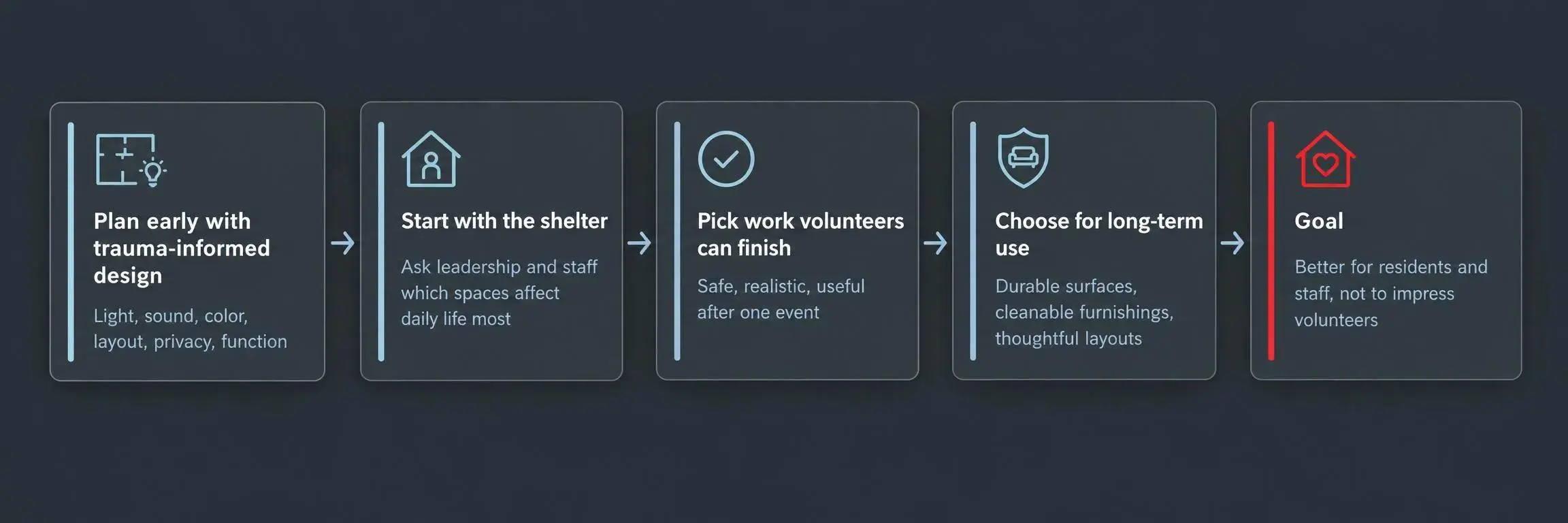
If you’re planning corporate volunteering at shelters, trauma-informed design should shape the decisions early. In plain language, that means thinking about light, sound, color, layout, privacy, and function so the space feels more supportive and respectful for people in crisis.
The sequence matters.
Start with the shelter
Talk with leadership and staff first. Ask which spaces affect daily life the most. Intake rooms, playrooms, kitchens, dining areas, lobbies, and bedrooms all carry different pressures.
Define what volunteers can actually finish
Choose work that is safe, realistic, and useful after one event. Overdecorating, adding clutter, or choosing hard-to-maintain finishes creates headaches that last longer than the volunteer day.
Choose materials and tasks for long-term use
A calming room isn’t built with random donations and leftover paint. It takes discipline. Durable surfaces, cleanable furnishings, and thoughtful layouts usually beat anything trendy.
When a project needs more than a cleanup or repaint, our Trauma-Informed Design approach can help shape the scope. And when the need has clearly grown beyond a one-day event, Full Shelter Renovations may be the better path, especially for dining rooms, kitchens, lobbies, playrooms, and other shared spaces.
The goal is not to impress volunteers. The goal is to leave the shelter working better for residents and staff.
Conclusion
The strongest team building volunteer ideas connect real team participation with real shelter needs. That might mean painting, organizing, building, installing, repairing, donating, or refreshing rooms. The format matters less than the fit.
The line between a generic service day and a meaningful one is usually planning. Dignity. Usefulness. A clear understanding of what daily life feels like inside the shelter.
Start by asking shelter staff what would help most right now. Then shape the volunteer day around that answer.
And if your shelter is ready for a more intentional room transformation or shared-space redesign, we can help bring that work into focus with trauma-informed planning and project support.