
An adopt a room program can go sideways when donors are asked to “decorate” without clear limits, safety rules, or a real picture of what families need. A beautiful room that lacks storage, soft light, or durable bedding still makes a hard day harder.
For shelter leaders, partners, donors, and volunteers, the work is simple but not easy: make each choice support rest, privacy, and daily life. Don’t let good intentions create more work for staff.
Start with the details that hold up:
- A room standard that prevents mismatched, unusable donations
- A budget that includes resets, repairs, and replacement linens
- Volunteer boundaries that protect resident privacy
Create spaces that feel safe to come home to.
What an Adopt-a-Room Program Really Means in a Shelter Setting
An adopt a room program is a structured way to invite donors, businesses, faith communities, families, or volunteer groups to fund and sometimes help complete the setup or refresh of a shelter room or shared space. In the best version, it isn’t “help us decorate.” It’s “help us make this room work better for people who are trying to sleep, think, calm down, care for their kids, and get through a hard stretch.”
That’s an important difference.
When people sponsor a shelter room, they’re not just paying for paint and bedding. They’re helping shape the daily conditions of recovery. Privacy. Rest. A place to put your things. A lamp that doesn’t feel harsh at 9 p.m. Space to help a child with homework without balancing papers on a bed.
Shelters usually use one of a few formats:
- One-time room setup for a new shelter, expansion, or newly reopened wing
- Annual room sponsorship to cover upkeep, linens, repairs, and replacement items
- Reset-between-residents support for spaces that turn over several times a year
- Time-based giving tiers such as one month, three months, or one year
Some room sponsorship campaign models stay focused on bedrooms or studio units. Others expand into living rooms, playrooms, libraries, pantries, kitchens, or intake areas. That move often makes sense sooner than people expect. A rough intake space can raise stress before a resident even reaches their room.
In a trauma-informed shelter, the room is part of care.
That’s the mental model we want leaders and donors to hold onto.
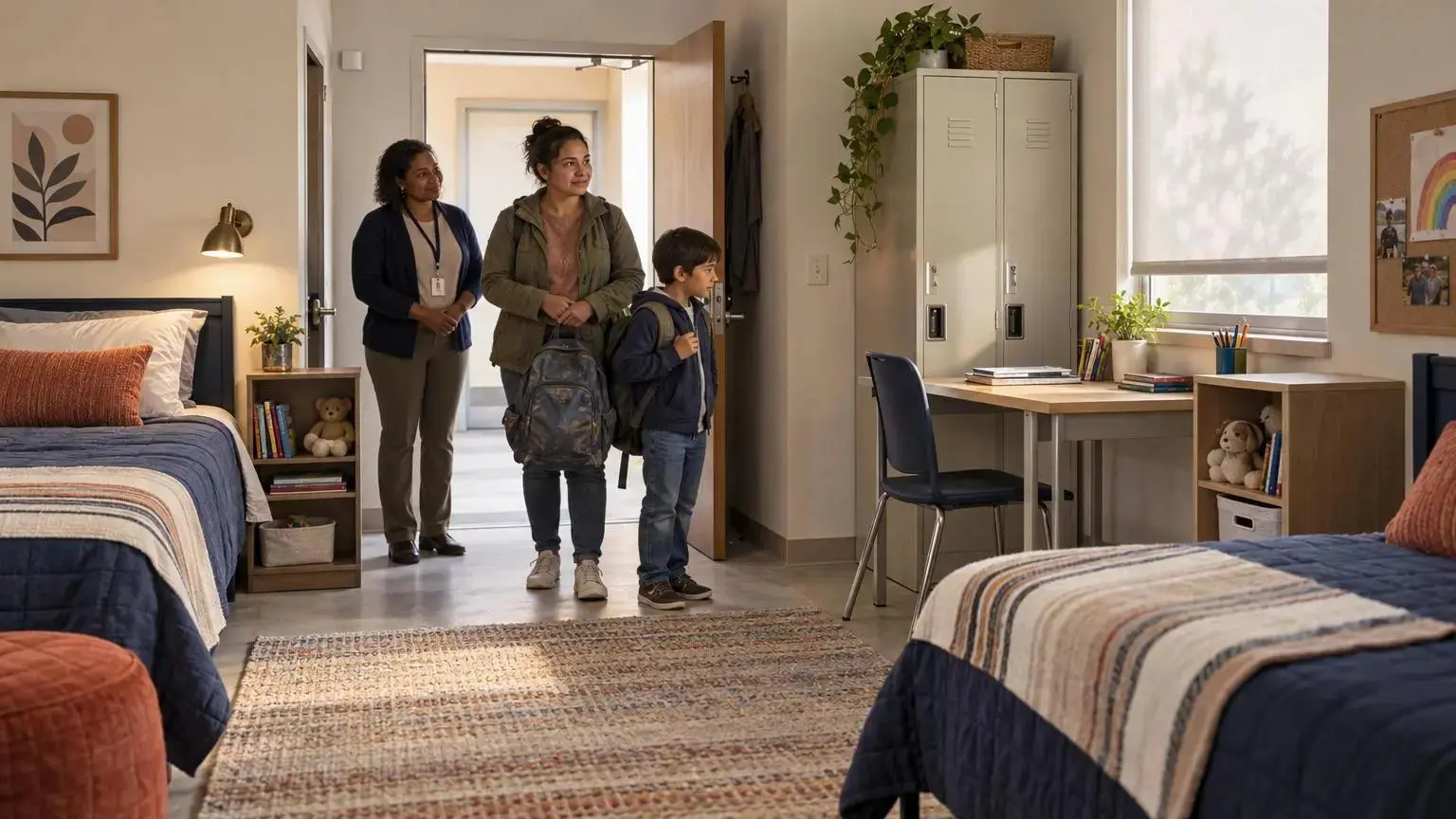
Why Trauma-Informed Design Should Shape Every Room Sponsorship Decision
Many residents arrive after violence, instability, loss, or displacement. So the environment lands harder than outsiders think. A cluttered room, nowhere to store belongings, harsh lighting, too much noise, no visual privacy, all of that can keep a person on edge.
Trauma-informed design changes the goal. You’re not trying to fill an empty room. You’re trying to make the room easier to use and easier to tolerate.
A sponsored room should account for practical details like these:
- Privacy and personal control
Even small choices matter. A place to keep belongings, a bedside light, a layout that doesn’t leave someone feeling exposed. - Layout and movement
Families need to move through the room without bumping into furniture or stepping over bags. - Color and visual calm
Soft, steady colors usually age better and feel better than highly themed choices. - Lighting
Warm, usable light beats a room that depends on one bright overhead fixture. - Less clutter
Too many decorative items can make a room feel busier, not kinder. - Comfort and durability
Soft textures matter, but so do washable surfaces and furniture that survives turnover. - Dedicated zones
When possible, make clear space for sleep, storage, study, or children’s play.
We still hear the objection that room makeovers are “just aesthetic.” We don’t agree. Environment affects sleep, regulation, and dignity. That’s not fluff. New York City’s EmPWR evaluation found that shelter redesign was linked to better resident and staff feedback on safety, mood, comfort, and wellbeing. On our own site, we’ve also shared a reported 63% increase in feelings of safety tied to this kind of work.
At A Lotta Love, our Trauma-Informed Design approach starts before the shopping list. We look at resident needs, privacy, layout, light, sound, and furnishings first. Otherwise you can spend good money and still end up with a room that photographs well but doesn’t function.
The Best Adopt-a-Room Program Models to Borrow and Adapt
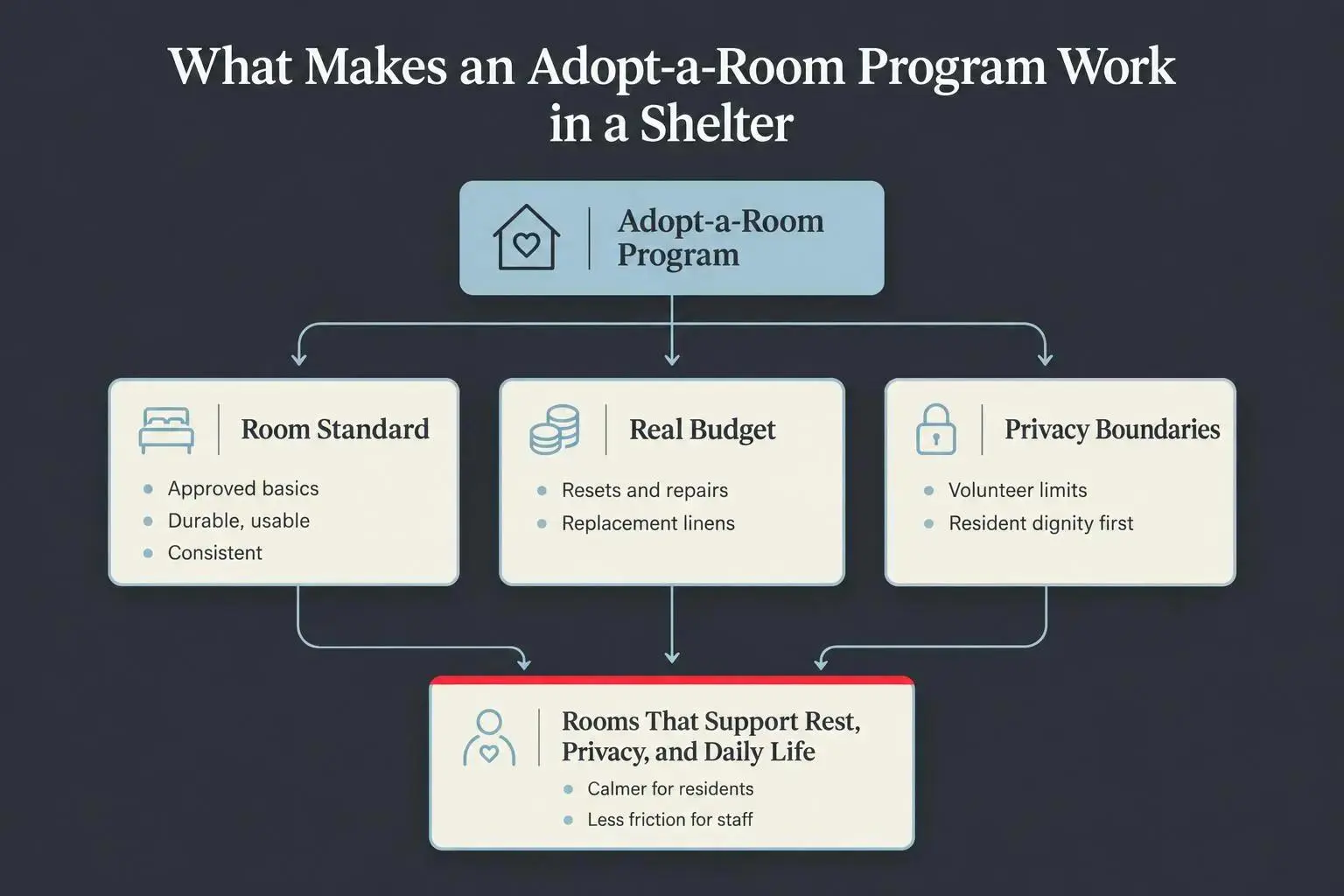
There isn’t one right model. The right model is the one your staff can actually run without resenting it three months later.
Full bedroom adoption
This is the cleanest model for many shelters. A donor funds the furniture, bedding, decor, and setup for one room. It’s useful for new shelter openings, expansions, or deep resets where the room needs more than a quick refresh.
Common add-ons include a sponsor plaque and a volunteer setup day. Those can work well, if staff still control the plan.
Annual upkeep sponsorship
This model covers repainting, deep cleaning, linens, replacement furniture, and repairs over a year. It’s often a better fit than one-time adoption for shelters with heavy turnover. Rooms wear down fast. Especially family rooms.
Reset-between-residents support
This one is practical and often underused. Sponsors help restock essentials every time a family moves out and a new one moves in. Bedding, towels, dishes, cookware, cleaning supplies, shower curtains, laundry basics. In studio-style family units, this model can matter more than decor.
Tiered time sponsorship
One month, three months, six months, nine months, twelve months. Simple asks convert better than vague ones. Time-based sponsorship also helps domestic violence and crisis shelters match giving to operating cycles.
Financial sponsorship with staff-led execution
Some donors want to help but can’t shop, paint, or show up. Good. Don’t force it. Financial sponsorship with staff-led design gives you tighter control over safety, quality, and consistency.
Shared-space adoption
When bedrooms are limited, or when common areas are the bigger stress point, extend the campaign to play areas, libraries, living rooms, computer nooks, pantries, or intake rooms. A cramped, chaotic shared room can undo a lot of good work elsewhere.
Borrow the model. Don’t copy the mechanics blindly.
Adopt-a-Room Program Ideas That Support Healing, Not Just Furnishing
A strong adopt a room nonprofit idea explains why each item matters. Donors respond better when they can connect a purchase to a real part of daily life.
Here are the categories we think carry the most weight:
Welcome and settling-in
- handwritten welcome notes
- simple comfort baskets within shelter guidelines
- child-friendly touches that feel warm without overloading the room
Sleep and rest
- quality bedding
- calming blankets
- blackout-friendly window coverings where appropriate
- softer lighting when policy and wiring allow it
Dignity and storage
- dressers or wardrobes
- hangers
- mirrors only if your safety rules allow them
- laundry baskets
- practical household basics
Family-friendly function
- a small desk or study spot
- books or toys for children when appropriate
- kitchenette starter kits in family units
Sensory calm
- neutral paint
- soft rugs if allowed
- minimal wall art
- layouts that reduce visual noise
Privacy support
- better furniture placement
- dividers or curtains where policy permits
- arrangements that help residents feel less on display
Shared spaces deserve the same level of thought. A calmer intake room can reduce panic during arrival. A play corner can give a parent five minutes to fill out forms. A common living room that feels less institutional changes how a whole floor functions.
Small room choices carry emotional weight. Not because they’re sentimental. Because people feel them in their bodies.
What Sponsors Can Fund, Provide, or Help Set Up
If you want a campaign to work, your asks have to be clear. Most donor confusion starts when everything gets lumped into one vague request.
Sponsors can usually help in four ways.
Monetary giving
- full room sponsorship
- partial support for a room reset
- annual maintenance funding
- support for a shared-space refresh
In-kind items
- bedding, towels, curtains, artwork, dishes, cookware, desk lamps, cleaning supplies, and other approved basics
Hands-on help
- painting
- decorating within a preapproved plan
- setup days
- welcome kits or supply bundles
Recognition options
- room naming
- plaques
- newsletter or event acknowledgment
This is also where shelters get into trouble if they aren’t firm. Some groups allow gently used furniture. Others don’t. Most will restrict used mattresses, pillows, or sheets. Many also prohibit glass, candles, air fresheners, razors, or electronics in resident rooms.
Say that early. Put it in every sponsor packet.
You can care about donor choice and resident safety at the same time. In fact, a good room sponsorship campaign requires both.
How to Build a Trauma-Informed Room Wishlist Without Overcomplicating It
Skip the giant generic donation list. Build a room-specific wishlist instead.
We suggest organizing it into a few practical categories:
- sleep essentials
- furniture and storage
- bath and personal care
- study or work area
- children’s needs
- decor and comfort items
- room reset and cleaning supplies
Then add a short note under each category explaining the purpose. Not marketing language. Just the truth. For example: storage helps families keep belongings contained and reduces room stress. A desk gives children a place for schoolwork. Extra linens make room resets faster and cleaner.
It also helps to split the list into:
- Essential items
- Optional finishing touches
That keeps donors from spending the whole budget on decorative pieces while the room still lacks a dresser or blackout curtains.
A few operating realities should shape every wishlist:
- choose durable over trendy
- use easy-to-clean materials
- respect small room footprints
- assume resident turnover
- account for staff reset time
Style guidance matters too. If five donors are buying five versions of “cozy,” you may end up with visual chaos. Some shelters allow sponsors to paint or choose from preapproved palettes. Others keep all design decisions centralized. Both can work.
Our Room Makeovers service is built around this exact issue: balancing calm, function, personalization, and the real limits shelters deal with every day.
Setting Budgets and Sponsorship Levels That Donors Can Say Yes To
Pricing is not a side detail. It often decides whether the campaign gets traction or stalls.
There are three practical ways to price an adopt a room program:
All-in room rate
One clear number for one bedroom or one family unit. Simple works.
Tiered levels
Give by month, quarter, half-year, or year. This lowers the entry point without muddying the offer.
Menu pricing
Separate prices for bedrooms, family studios, and shared spaces. This helps when your needs vary a lot across the building.
Real-world ranges are all over the map, but some patterns are useful. Replenishment-focused partnerships can run in the hundreds per year. Annual room sponsorships often land in the low four figures. Heavy-use shelter bedrooms may need several thousand dollars a year. Shared spaces can cost more than bedrooms because they take more traffic and equipment.
A sponsor price should usually account for:
- furniture or replacement furniture
- bedding and linens
- paint and supplies
- lighting or window treatments if needed
- cleaning and reset costs
- staff coordination time
- a reserve for wear and tear
Be explicit about whether the price covers setup only or ongoing maintenance too. And if a room may need two or three refreshes a year, say that upfront. Vague pricing sounds easier. It usually performs worse.
| Offer example | Offer structure | Low price | High price | What this price point signals |
|---|---|---|---|---|
| My Father's House family studio reset | Annual replenishment partnership for essentials; furniture remains in place | $600 | $800 | Shows the hundreds-per-year range when the sponsor mainly restocks essentials between resident stays. |
| Turning Pointe annual room sponsorship | Annual room sponsorship for bedding, supplies, and new furniture as needed | $1,200 | $1,200 | Fits the low-four-figure annual sponsorship pattern. |
| Safe Shelter client bedroom sponsorship | Annual bedroom sponsorship covering furniture, lighting, window coverings, bedding, linens, deep cleaning, and painting | $3,000 | $3,000 | Shows a several-thousand-dollar bedroom ask when rooms see heavy wear and repeat use. |
| DVRC one-month room sponsorship | Tiered time sponsorship for 1 month | $1,000 | $1,000 | Gives donors a lower entry point without changing the core offer. |
| DVRC twelve-month room sponsorship | Tiered time sponsorship for 12 months | $10,000 | $10,000 | Shows how the same tiered program can also present a full-year anchor gift. |
| Barrett computer room and library | Menu-priced shared-space sponsorship | $5,000 | $5,000 | Example of separating shared spaces into their own price line when needs vary across the building. |
| Barrett common living room | Menu-priced shared-space sponsorship | $10,000 | $10,000 | Shows how some shared spaces can sit above bedroom sponsorship levels because of traffic and equipment needs. |
What Published Sponsorship Prices Reveal About Setting an Ask
Published program pages show that a “room” can represent very different commitments. In these examples, an annual studio-replenishment commitment at My Father’s House is listed at $600–$800, while a 12-month room sponsorship at DVRC is listed at $10,000. The intervening asks cover both bedrooms and shared spaces at Turning Pointe, the Barrett Foundation, and Safe Shelter.
These are program-specific posted asks, not a market-rate survey. They illustrate why a sponsorship level needs a defined scope, term, and list of included costs before it is presented to donors.
Posted sponsorship asks from six shelter-program examples. The My Father’s House bar shows its stated annual range; equal endpoints indicate a single stated ask. Offer scope and term differ across programs.
| Program and sponsorship scope | Low posted ask | High posted ask |
|---|---|---|
| My Father’s House — annual studio replenishment | 600 | 800 |
| Turning Pointe — room, annual | 1,200 | 1,200 |
| Barrett Foundation — kitchen pantry | 2,000 | 2,000 |
| Safe Shelter — client bedroom, annual | 3,000 | 3,000 |
| Barrett Foundation — computer room and library | 5,000 | 5,000 |
| DVRC — room, 12 months | 10,000 | 10,000 |
Source: Sources: My Father’s House; Turning Pointe; Barrett Foundation; Safe Shelter; DVRC.
- This is a small convenience sample of publicly posted program asks, not a representative survey of shelters.
- The offers differ in space type, sponsorship term, geography, and included costs; they should not be treated as like-for-like operating costs.
- Published asks can change, and the Barrett Foundation shared-space amounts do not specify a sponsorship term in the available evidence.
View chart data
| Program and sponsorship scope | Low posted ask | High posted ask |
|---|---|---|
| My Father’s House — annual studio replenishment | 600 | 800 |
| Turning Pointe — room, annual | 1,200 | 1,200 |
| Barrett Foundation — kitchen pantry | 2,000 | 2,000 |
| Safe Shelter — client bedroom, annual | 3,000 | 3,000 |
| Barrett Foundation — computer room and library | 5,000 | 5,000 |
| DVRC — room, 12 months | 10,000 | 10,000 |
That spread is a practical argument for menu pricing. Define whether each level covers one reset, annual upkeep, a bedroom, or a shared space—and state whether it includes coordination, cleaning, replacement furniture, and supplies. A lower-priced replenishment partnership and a higher-priced room adoption may both be honest asks, but they are not interchangeable products.
Designing a Donor Experience That Builds Long-Term Support
A room sponsorship campaign can be a retention tool if you design it that way. People stay involved when they can see the shape of their contribution without crossing ethical lines.
A typical donor experience might include:
- room selection or assignment
- a tour, when appropriate
- an approved design brief or wishlist
- a volunteer setup day
- a plaque or public thank-you
- updates on impact that protect resident privacy
Tactile involvement matters. Companies, churches, school groups, and families often become more committed when they can paint a wall, make a bed, or stock a shelf. But not everyone wants the same level of involvement, so give options. DIY within guidelines, fund-only, or a hybrid where staff handle sourcing and layout.
Be careful with storytelling. Residents are not campaign props. The story should stay with the space and what it makes possible: better rest, calmer arrivals, more dignity, fewer daily frictions. That’s enough.
A few donor engagement through room sponsorship ideas tend to work well over time:
- annual renewal invitations
- seasonal room refreshes
- updates on shared-space use
- small volunteer return days for resets or re-stocking
Recognition can help. It just shouldn’t become the point.
Operational Details That Make or Break the Program
This is the part people skip. Then the program becomes a burden.
Before launch, decide who approves design plans, purchases, color palettes, setup schedules, and volunteer access. Establish procurement rules early: what must be new, what can be gently used, what is prohibited, who receives deliveries, and who installs items.
You also need a plan for turnover.
- Where are backup supplies stored?
- How are replacement items tracked?
- What happens when approved items leave with residents?
- Who resets the room, and when?
Confidential shelter locations need tighter volunteer boundaries. So do programs serving survivors of violence. Staff should never have to negotiate privacy rules on the fly with a well-meaning donor group in the lobby.
Make a one-page sponsor guide. Really. It saves hours.
The guide should cover room rules, timelines, item approvals, delivery instructions, volunteer limits, and who to contact with questions. And your development, operations, and facilities teams need to agree before the campaign goes public. If those groups aren’t aligned, the fundraising idea will outrun the building.
Measuring Impact Beyond Before-and-After Photos
Photos matter. They’re just not enough.
Measure the campaign in two directions: fundraising performance and resident-centered impact.
Useful campaign metrics include:
- rooms or shared spaces sponsored
- percent of goal funded
- sponsor renewal rate
- volunteer participation
- time needed to reset a room
Mission metrics are usually more revealing:
- resident and staff feedback on comfort, calm, privacy, and usability
- fewer delays in getting rooms stocked and ready
- more consistency across rooms
- stronger staff morale in better-supported spaces
The strongest stories connect room changes to human outcomes. Easier sleep. Less overwhelm at arrival. Better storage. A space that feels respectful instead of improvised.
Do short reflection loops after each project. Ask staff what worked, what wore down fast, what felt impractical by the second week. When appropriate, ask residents too. That’s where you learn whether the room actually functions.
Common Mistakes in an Adopt-a-Room Program and How to Avoid Them
A lot can go wrong quietly. Most of it is preventable.
Treating every donated item as helpful
Curate for safety, durability, and fit. Gratitude doesn’t require accepting unusable items.Launching without a room standard
Create a baseline for every room. Otherwise one family gets a coherent setup and the next gets leftovers.Promising too much donor creative freedom
Set boundaries early. Trauma-informed and operational rules have to win.Funding the reveal but not the resets
Budget for wear, replacement, and labor. Opening day is not the hard part.Letting recognition overshadow dignity
Keep names on plaques, not residents in marketing.Pushing extra labor onto staff
Build coordination and reset time into the budget from day one.Ignoring common areas
Bedrooms matter, but so do intake rooms, playrooms, and living spaces.Talking about decor instead of function
Explain how the environment affects privacy, regulation, sleep, and daily stability.
A shelter room doesn’t need to look expensive. It needs to feel usable, calm, and respectful.
When to Focus on One Room, a Cluster of Rooms, or a Full Shelter Renovation
The right scope depends on the problem.
A one-room pilot makes sense when you want a manageable test, when your donor community is new to room sponsorship, or when one resident space has become urgent.
A multi-room campaign works when several bedrooms need consistency, when you have a repeatable room template, or when a corporate or community partner wants broader visible impact.
A shared-space adoption effort is often the better choice when resident flow depends heavily on common rooms. If the biggest pressure points happen in the intake area, living room, playroom, or kitchen, start there.
A full shelter renovation becomes the right call when room-level fixes won’t solve the bigger issue. If lighting, flooring, paint, furniture, and shared areas all work against the experience of safety and calm, piecemeal updates can waste money. Our Full Shelter Renovations work is meant for exactly that kind of situation.
Not every problem starts at the same scale. Don’t force it.
Conclusion
The best adopt a room program is not a decorating fundraiser with a nicer name. It’s a structured, trauma-informed way to turn community generosity into spaces that feel safer, calmer, and more dignified for people in crisis.
If you’re building one, keep the path practical. Choose the sponsorship model that fits your operations. Set room standards before donors get involved. Price the work clearly. Design the donor experience with boundaries. Measure results in human terms, not just dollars raised.
Start with one room or one shared space. Audit it honestly. Then build a room sponsorship campaign around the changes that would most improve rest, privacy, comfort, and daily life. That’s where the work gets real.