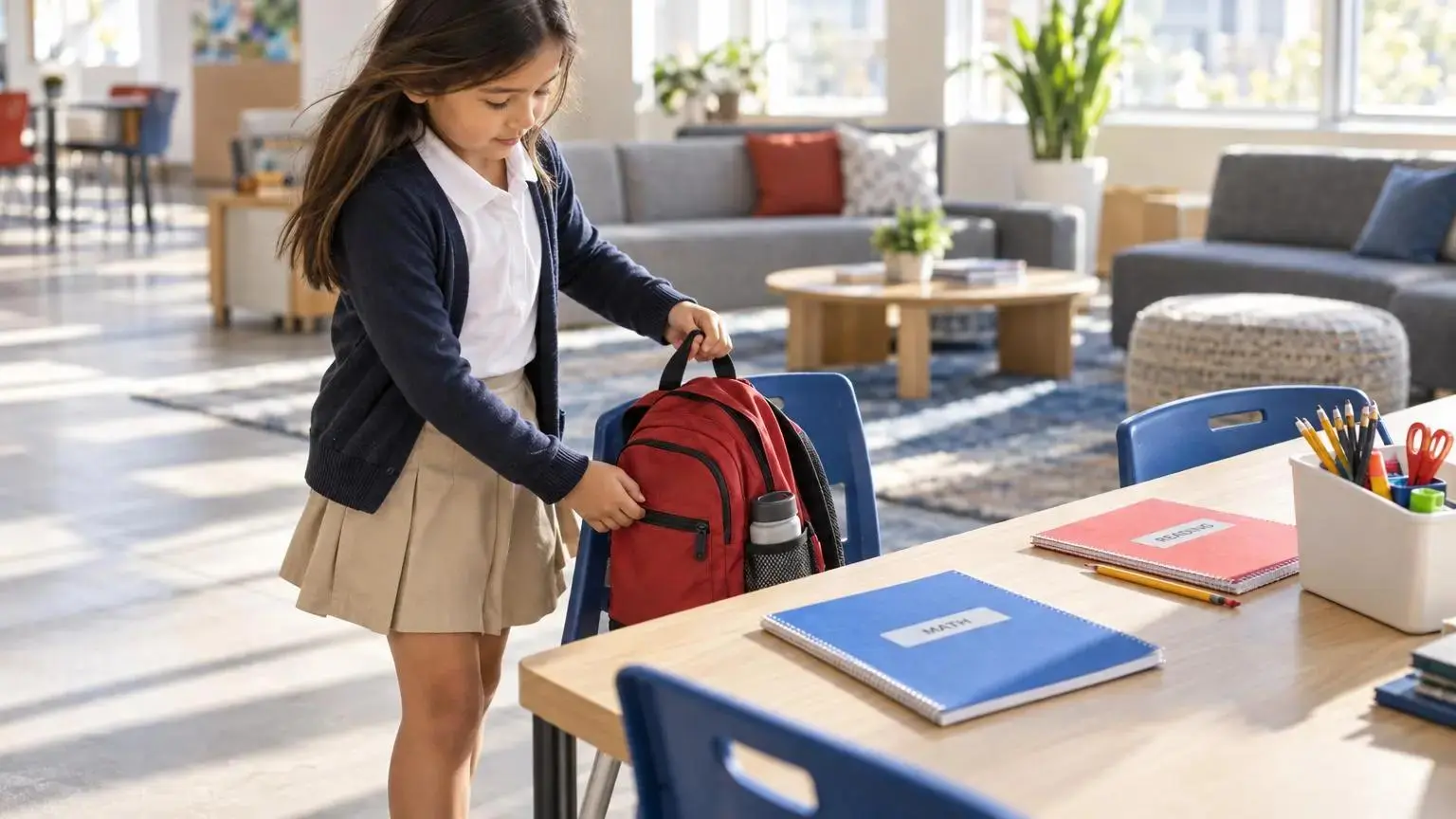
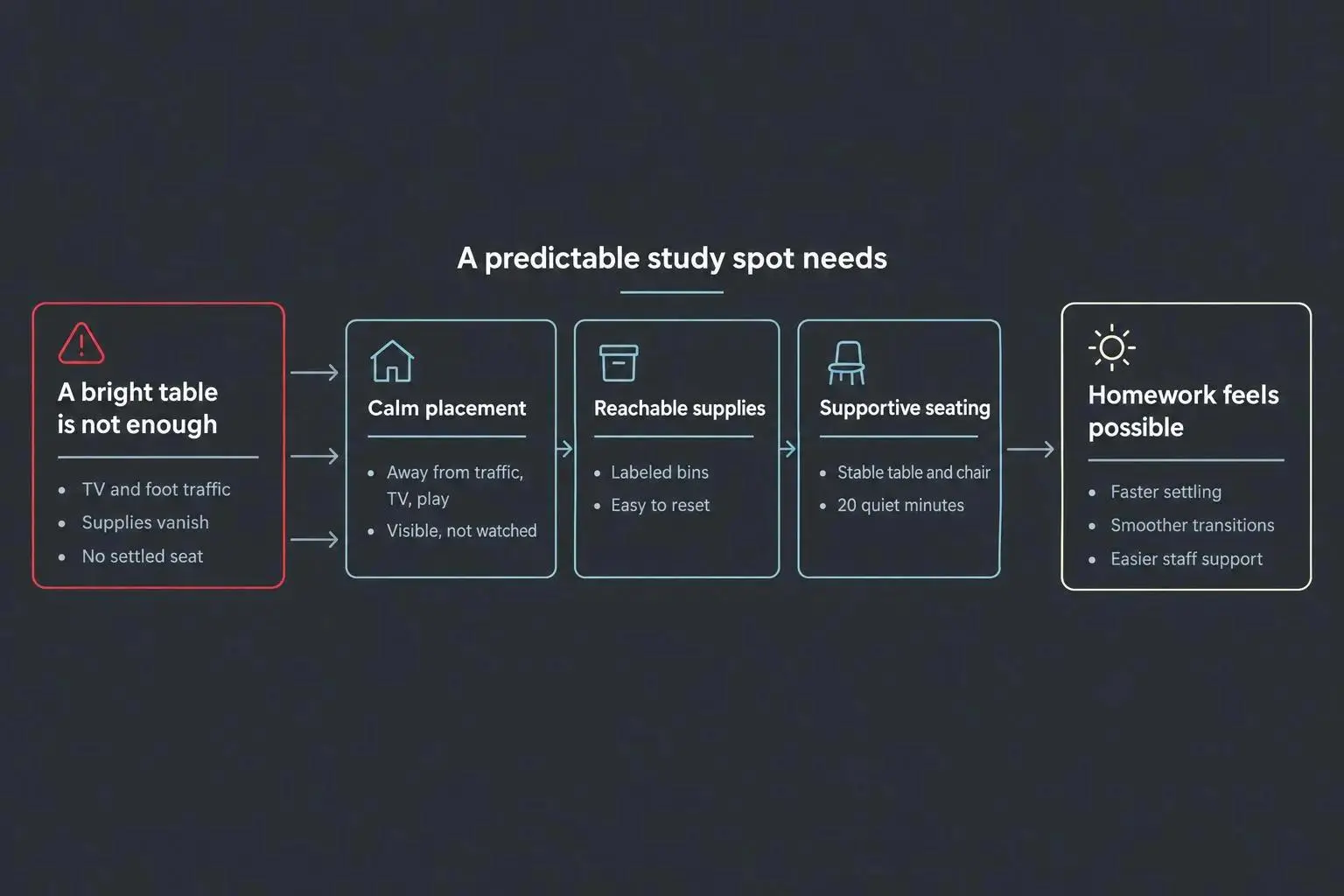
A study space in shelters can fail before homework even starts: it’s wedged by the TV, supplies vanish, and kids have nowhere to settle. A bright table alone won’t fix that.
What works is a predictable spot that feels calm, visible without feeling watched, and easy to reset after a hard day. Small choices matter (especially at 4 p.m.).
Start by checking for:
- A table away from foot traffic, screens, and active play
- Labeled supply bins children can reach without asking
- Seating that supports 20 quiet minutes of work
Make homework feel possible tonight.
Why a Study Space in Shelters Matters More Than It May Seem
A study space in shelters isn’t really about a desk. It’s about whether a child can find their footing at the end of a hard day.
Homework gets harder fast when a child is living in a place with shared rooms, shifting routines, noise from the hallway, and very little privacy. Even a motivated kid can hit a wall when there is nowhere clear to sit, no place to keep supplies, and no signal that this part of the day has a shape.
That’s the piece people miss. A consistent homework area shelter kids can return to each day does more than hold pencils and folders. It tells them, “This is where school still happens. This part of life is still intact.”
For shelter leaders, this can feel like one more thing on top of urgent needs. Beds matter. Meals matter. Safety planning matters. We know that. But educational support isn’t extra. When a child has no usable after school area in shelters, staff often end up managing frustration, conflict, and shutdown instead of just helping with homework.
A usable study area can help with all of this:
- less wandering during homework time
- fewer arguments over where to work
- easier staff support
- more predictable transitions after school
- a stronger sense of dignity for children and caregivers
The goal isn’t a perfect classroom. It rarely needs to be permanent, polished, or expensive. It needs to work. Calm beats cute every time.
What Makes a Study Space in Shelters Feel Safe Enough to Learn
Children learn better when a space is easy to read. That matters even more in crisis settings, where stress is already high and attention is harder to hold.
For us, trauma-informed design starts with a simple question: does the space lower stress, or add to it? In a learning corner for shelter children, that shows up in light, sound, layout, privacy, color, and comfort. Not as decoration. As function.
A visually attractive area can still fail if it’s loud, cluttered, overbright, or confusing. We’ve all seen spaces that look cheerful but make kids more restless within ten minutes.
The design priorities that matter most
A child shouldn’t have to figure out the room before they can start their homework. Keep the setup legible.
- Clear boundaries: Kids should know where homework happens without being told five times. A rug, a shelf, or a wall color shift can do the job.
- Lower noise and clutter: Busy walls and open bins full of random supplies don’t help. They pull attention in every direction.
- Right-size furniture: If the chair is too tall, too low, or too soft, the work gets harder than it needs to be.
- Simple storage: Children and volunteers should be able to reset the space in a minute or two.
- A bit of ownership: Labels, a consistent seat, or a familiar bin can help, as long as the system stays easy to maintain.
A good study space should feel predictable before it feels impressive.
Our Trauma-Informed Design approach centers safety, dignity, connection, and healing. That’s especially useful in shelter learning spaces, because the room is doing quiet emotional work whether you intend it to or not.
Where to Put the Homework Area so It Actually Gets Used
Placement decides whether the space becomes part of daily life or turns into furniture nobody touches.
Most shelters don’t have a spare room waiting to become a homework center. So the real question is not “Where would this be ideal?” It’s “Where can children actually use this consistently without too much friction?”
Common location options and the tradeoffs
A corner of a family room can work well for a single family or a small number of children. It feels familiar and close to caregivers, but it can get noisy fast.
A shared common room gives you more room and better staff visibility. It also brings more movement, more interruptions, and more chances for supplies to spread.
A converted nook near staff visibility is often one of the better options. Kids feel supported, but you have to be careful it doesn’t feel like they’re being watched from all angles.
A section of a playroom or dining area used after school can work if the transition is consistent. If toys stay in sight and snack cleanup drags on, focus usually disappears by the second afternoon.
What to avoid if you can
Some spaces fight you no matter how much effort you put in.
- hallway-adjacent spots with steady foot traffic
- rooms where the television stays on
- areas used for intake or other emotionally charged activity
- harsh overhead lighting
- corners with no nearby outlet when older kids need device access
The best after school area in shelters is usually:
- away from the loudest activity
- easy to reach right after school
- close enough for staff or volunteers to help
- defined enough that it doesn’t take over the whole room
If you have no extra room, don’t wait for one. A time-based setup in a multipurpose area is often better than a “someday” permanent room that never happens. Predictable use matters more than permanent walls.
| Option | Strengths | Main friction | Best fit |
|---|---|---|---|
| Corner of a family room | Feels familiar and stays close to caregivers | Can get noisy fast | Single family or a small number of children |
| Shared common room | More room and better staff visibility | More movement, more interruptions, and more chances for supplies to spread | When space is limited but staff line of sight matters |
| Converted nook near staff visibility | Kids feel supported and the spot is often one of the better options | Can feel over-monitored if children seem watched from all angles | When you can balance support with some sense of privacy |
| Section of a playroom or dining area used after school | Can work in a multipurpose space | Focus drops if toys stay visible or snack cleanup drags on | When the daily transition into homework time is consistent |
The Essential Elements of a Shelter Study Table Setup
A shelter study table setup doesn’t need much, but every piece has to earn its place. If one element is off, the whole routine gets shakier.
Start with the work surface. It should be stable, easy to clean, and large enough for a notebook, folder, and maybe a device. Wobbly card tables create more irritation than people expect. Rounded edges are better when possible, especially in mixed-use family spaces.
Seating matters just as much. Children need chairs that support 20 to 45 minutes of work without feeling punishing. Soft lounge chairs seem welcoming, but they are bad for writing. That’s a common mistake.
For lighting, aim for even, calm light with low glare. If the overhead fixture is harsh, shift the table placement or soften the zone visually with nearby finishes and materials. You may not be able to replace the light right away, but you can stop placing the work surface in the worst spot.
A strong setup usually includes:
- clearly labeled bins or drawers for supplies
- a reset system children can learn quickly
- visual boundaries such as a rug, shelf, or furniture placement
- simple focus supports like folders, homework trays, timers, or a visual schedule
- a few soft textures nearby, without turning the area into a sensory pileup
Keep pathways open. Watch cords. Remove unstable pieces before someone leans on them. Safety problems tend to show up in the small stuff.
Kids Homework Station Ideas for Different Ages and Shelter Setups
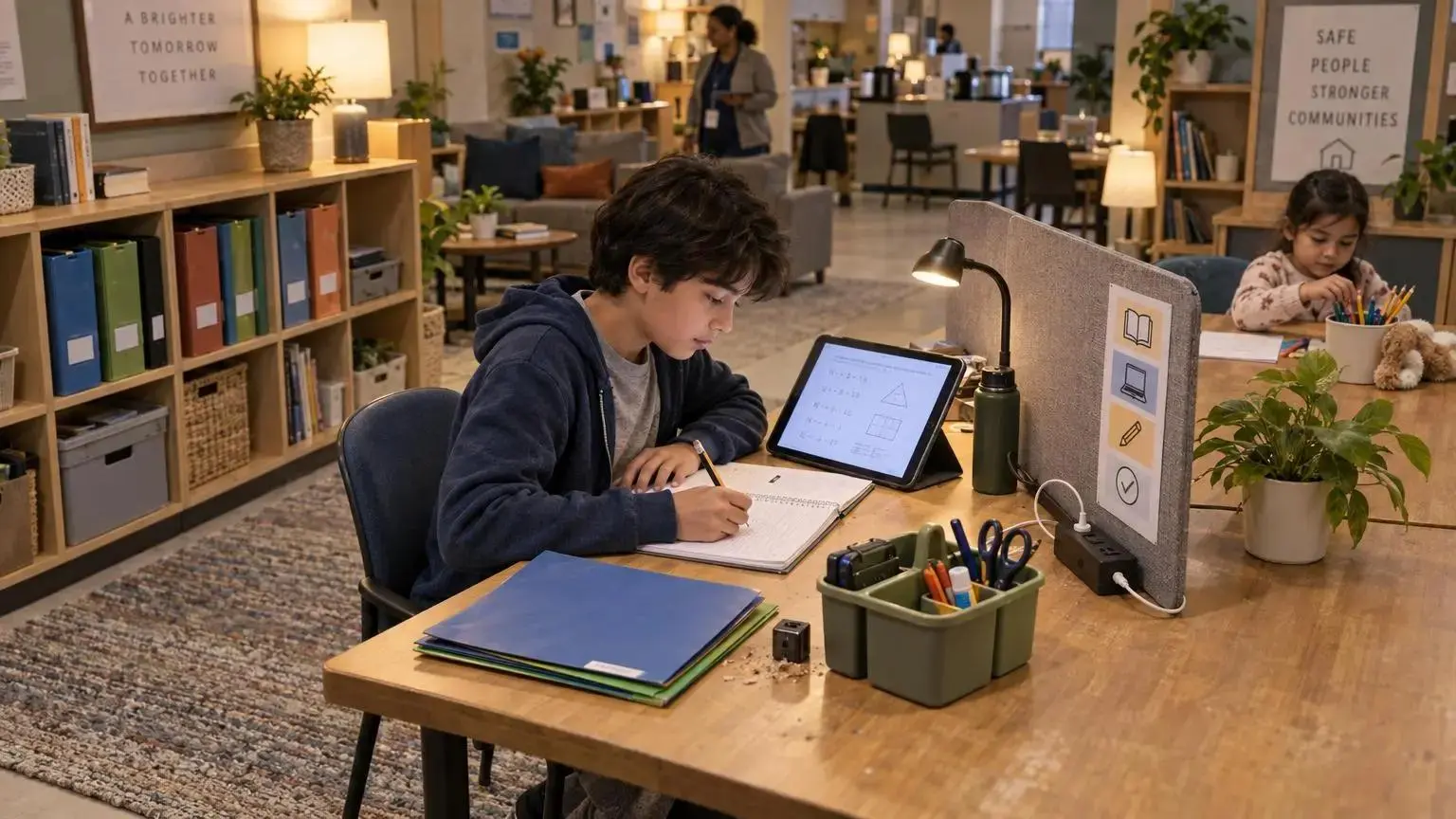
Not every child uses a homework area the same way. Age matters, but so does the kind of shelter setup you’re working with.
A six-year-old often needs a shorter work block, fewer visible choices, and more help transitioning in. A middle schooler may want the opposite. More privacy. More surface area. A place to charge a device and sort work by subject.
By age
For early elementary, keep the setup low, simple, and visual. Easy-reach supplies help. So does a nearby calming element, like a neutral rug or a predictable visual schedule. These children usually don’t need more stuff. They need less friction.
For upper elementary, independence starts to matter. Give them space to read and write side by side, plus a basic checklist for multi-step assignments. Once they can track “math, reading, pack folder,” the routine often gets smoother.
Middle school students usually need more than people realize:
- room for larger books and multiple subjects
- a place to plug in a device
- stronger storage systems
- a bit more visual privacy
By shelter setup
In a family room setup, a compact desk or table against the wall often works best. Add a portable supply caddy and a focused light source if available. Keep it restrained.
In a common area setup, a group table can work if seating is structured and the routine is clear. Staff need line of sight, but children shouldn’t feel exposed. There’s a difference.
A learning corner for shelter children is often the best answer for small footprints. Shelving, rug placement, and a few consistent wall cues can carve out a real study zone without boxing children in.
How to Reduce Noise, Distraction, and Sensory Overload
Most shelters were not built for concentration. That’s just true. But you can still make homework time calmer without tearing walls open.
Noise control often comes down to layout, timing, soft materials, and behavior norms. Expensive construction is rarely the first fix.
What the research says about noise
This is more than a comfort issue. A 2025 meta-analysis of 21 studies, representing 152 effect sizes, found a moderate negative association between environmental or classroom noise and students’ cognitive or academic performance (pooled effect size: -0.46; 95% CI: -0.54 to -0.38). The studies varied substantially in noise source and design, and they were not conducted in shelters, but the result gives a measurable reason to treat TV sound, active play, and steady foot traffic as learning barriers rather than minor inconveniences.
Try a few practical moves first:
- move the study area away from televisions and active play
- use bookcases or furniture as partial buffers
- keep wall visuals limited in the homework zone
- store extra supplies out of sight
- reduce crowding during homework hours if you can
Visual simplicity helps more than people expect. Children in stress often scan everything. If every surface is shouting for attention, their brains stay busy before the worksheet even comes out.
A few overlooked barriers are worth watching:
- strong scents from cleaning products or food
- rooms that run too warm
- tight seating arrangements that leave children bumping elbows
A short transition ritual can help settle the whole group. Snack first. Supply pickup. Quiet work begins. The order matters because the body often needs a cue before the brain can focus.
Some children need lower stimulation. Others do better with gentle structure and moderate supervision. You don’t have to choose one model for everyone. You do need a space that can flex without becoming chaotic.
Simple Storage, Supplies, and Routines That Keep the Space Functional
The most beautiful setup falls apart if no one can find a pencil by Wednesday.
This is where many homework areas start strong and then quietly stop working. Supplies wander. Cleanup becomes vague. Volunteers improvise different systems. Children stop knowing what to expect.
Keep the supply kit basic and dependable:
- pencils
- erasers
- crayons or colored pencils
- paper
- folders
- pencil sharpeners
- child-safe scissors, if appropriate
Storage should lower stress, not create another sorting job. Individual homework bins can work well for regular users. Shared labeled containers make more sense in communal rooms. We also like a small backup bin for missing supplies so a broken pencil doesn’t derail the whole session.
A routine children can count on
A simple after school area in shelters often runs better with a repeatable sequence:
Sample after-school flow
- Check-in
check-in and snack
- Setup
five-minute setup
- Homework
quiet homework block
- Help
ask-for-help process
- Tidy
reset and tidy
That routine needs adults behind it. Staff and volunteers should know who greets children, who helps reset supplies, and how support is offered. Consistency matters more than perfection.
Avoid rules that feel punitive or suspicious. A child should not feel like borrowing a marker is a trust issue.
Budget-Friendly Ways to Build a Homework Area Without Making It Feel Temporary
Tight budgets are real. We don’t think that means children should get flimsy, mismatched leftovers and be told it’s good enough.
Thoughtful choices matter more than buying a lot. If you have limited funds, spend in this order:
- stable work surface
- decent seating
- lighting
- organized storage
- calming details
Repurpose durable tables already on site if they fit the children using them. Use matching bins to create visual order. Stick to a restrained color palette so the area feels calm instead of accidental. Add washable soft elements where practical, not everywhere.
A few low-budget mistakes cause trouble fast:
- accepting every donated item without checking function
- using oversized furniture that makes children look and feel small
- assuming any empty corner can become a study area
- piling toys, books, art supplies, and homework tools into one zone
For donors and volunteers, the most helpful gifts are often boring on paper: sturdy chairs, labeled bins, task lighting, folders, and durable surfaces that can take daily use.
Start with one dependable station. Learn from what children actually use. Then expand. Growth should follow real patterns, not enthusiasm alone.
When a Room-Level Fix Is Enough and When a Shared Area Needs a Bigger Redesign
Sometimes the problem is small and specific. Sometimes the room itself is working against you.
A room-level improvement may be enough if one family room or child bedroom simply lacks a place to do schoolwork. In that case, a desk, calmer layout, and better storage can change the experience without touching the rest of the building. That’s often where our Room Makeovers fit best, especially when a shelter wants a focused upgrade for families, women, or children in temporary housing.
A larger shared-area redesign makes more sense when homework happens in noisy common spaces, several groups compete for the same room after school, or the lighting, flooring, furniture, and flow all make focus harder. At that point, replacing one table won’t solve the actual problem. That’s where broader work, including shared spaces through Full Shelter Renovations, may be the better fit.
Here’s the blunt version:
If the routine keeps failing in the same room, the room is part of the problem.
You don’t need a huge project by default. But you do need to be honest about scope.
Common Mistakes That Undermine a Homework Area for Shelter Kids
Most bad homework setups don’t fail because people don’t care. They fail because the room gets planned around appearance, convenience, or donations instead of use.
Watch for these mistakes:
- placing the area where adults can see everything but children can focus on nothing
- filling the study zone with bright visuals, toys, or too much decoration
- skipping storage and cleanup systems
- choosing furniture that lasts but is miserable to sit in
- making the space so multipurpose that it loses all predictability
- expecting children to self-regulate with no routine
- using one setup for every age group
- treating the area like a donation drop zone
One of the biggest problems is mixing play, intake, storage overflow, and homework into one undefined patch of room. Children read that confusion immediately. If the space has no clear purpose, neither does the routine.
How to Know the Space Is Working
You don’t need a formal study to tell whether the area is helping. The signs show up in daily use.
Look for practical changes. Children return to the space willingly. Staff spend less time untangling homework chaos. Supplies stay easier to find. The area feels calmer during that after-school window when things usually get jagged.
A few signs matter more than perfect completion rates:
- children settle faster
- transitions feel smoother
- kids seem less overwhelmed
- more school tasks get finished, or at least attempted for longer
Ask children when it’s age-appropriate. Ask caregivers. Ask staff and volunteers who are there during homework time. Often the best feedback is simple: “This part feels easier now.”
Don’t treat the first setup as final. Move a table. Remove a distracting poster. Change the bin labels. Small adjustments are normal. In our work, the strongest spaces are usually refined over time, not solved in one pass.
Conclusion
A safe study space in shelters is not a luxury item. It’s a practical support for regulation, dignity, and continuity when a child’s life already feels unstable.
The homework area shelter kids can use consistently is usually not the fanciest one. It’s the one with a calm layout, clear routines, manageable storage, and furniture that fits the child doing the work. That’s what makes homework feel possible again.
Start with one change this week. A steadier table. A quieter corner. A routine children can count on.
Then build from there. A stronger learning corner for shelter children often begins with one clear message from the room itself: you are safe here, and your future still matters.